
What renovating a home in Perth actually costs
By Omar Costa · Updated 2026-07-13
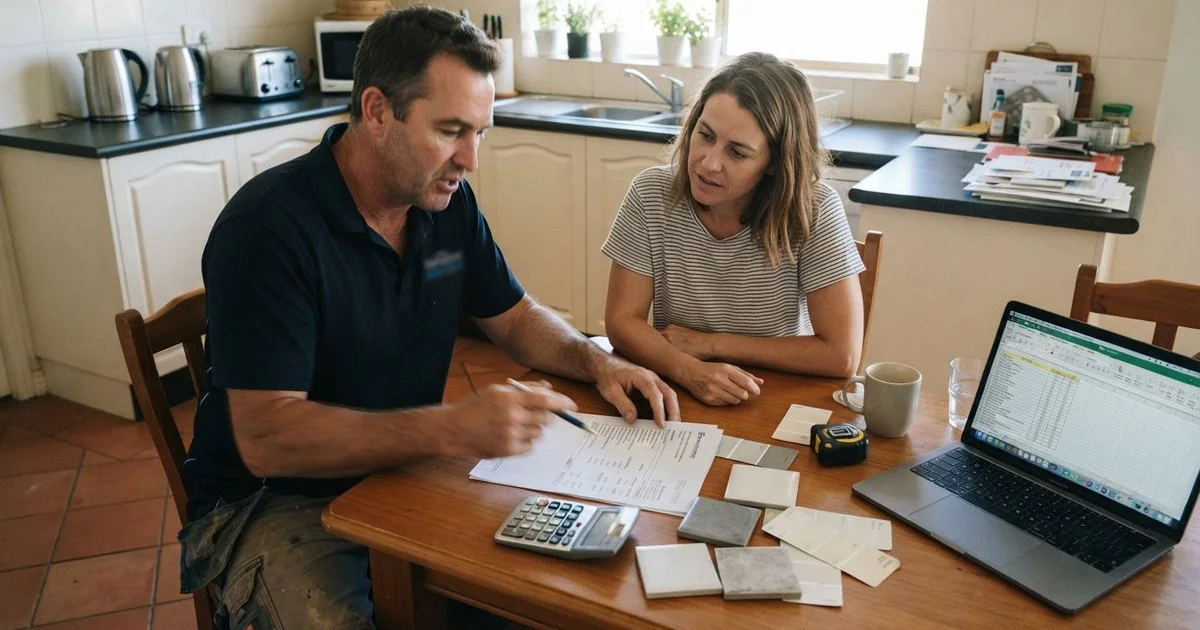
Renovation costs in Perth swing a lot depending on what you’re actually doing, and headline figures thrown around online rarely match a real quote. This guide sets out the ranges that tend to hold up across kitchen, bathroom, extension, full-home, granny flat and heritage projects, and the handful of factors that move a job from the bottom of a range to the top.
What drives the price, regardless of project type
Three things do most of the work in any renovation quote. Size is the obvious one: more square metres means more materials and more labour hours, full stop. Finish level is the second, and it’s often the biggest swing factor of all, since a budget laminate benchtop and a stone one with custom joinery can be double the price for the same footprint. The third is whether the layout changes. Keeping plumbing, walls and wiring where they already are is always cheaper than moving them, because relocating services means extra trades, extra time and, in older Perth homes, extra surprises once a wall or floor comes up.
Site access matters more than most people expect too. A block with tight side access, a steep driveway or no truck access adds cost simply because materials and waste have to move by hand instead of machine.
Typical price ranges by project
These are planning ranges, not quotes. Treat them as a starting point for a conversation with a contractor, not a number to hold anyone to.
| Project type | Typical range | What pushes it to the top |
|---|---|---|
| Bathroom renovation | Roughly $15,000–$40,000+ | Moving the shower or toilet, premium tiles, a freestanding bath |
| Kitchen renovation | Roughly $10,000–$45,000+ | Stone benchtops, custom joinery, moving the sink or cooktop |
| Home extension | Low tens of thousands to $100,000+ | Second storey, restricted site access, kitchen or bathroom included |
| Full home renovation | Roughly $80,000 to $250,000+ | Structural changes, full rewiring and replumbing, larger floor plans |
| Granny flat / ADU | Roughly $90,000–$180,000 | Two or three bedrooms, premium finish, difficult site works |
| Heritage restoration | Roughly $20,000 for a single room to $300,000+ | Full re-stumping, render repair, heritage-compliant materials |
If you want a starting figure specific to your own kitchen, bathroom, extension or granny flat rather than a general range, this site’s free project calculators walk through size and finish choices and give a planning estimate in a couple of minutes. If you’re specifically planning a home extension rather than a single-room renovation, the home extension cost guide breaks down what pushes a quote toward the top of that range.
Where the money actually goes
For most jobs, labour and trades make up a bigger share of the bill than materials, especially once plumbing, electrical, waterproofing and tiling are all involved. That’s part of why a small bathroom can still cost a meaningful amount even with modest fittings: the waterproofing, tiling and plumbing labour doesn’t shrink much just because the room is small. Demolition and disposal, though rarely the headline item, also add up quickly on older homes where extra care is needed around asbestos sheeting or lead paint.
Contingency is worth budgeting for separately rather than hoping you won’t need it. A sensible allowance is somewhere between 10% and 20% on top of the quoted price, held back specifically for what turns up once walls, floors or old cabinetry come out. On an older Perth property this isn’t a worst-case scenario, it’s closer to the norm.
Getting a number you can trust
The biggest single mistake in renovation budgeting isn’t picking the wrong contractor, it’s comparing quotes that aren’t actually for the same job. Before you weigh up price, make sure each quote covers the same scope: same fixtures and finish level, same inclusions for demolition and waste removal, same allowance (or lack of one) for unexpected findings. A contractor who explains what could push the price up, rather than promising a number will never change, is usually the safer one to work with.
You can browse this site’s ranked local contractors from the home page once you have a rough budget in mind, and the scoring behind every ranking is explained in full on our methodology page.
This guide gives planning ranges only. A firm price always requires a site visit or, at minimum, detailed photos and measurements, since access, existing condition and council requirements can all move the final number.
Common questions
- Why do two quotes for the same job come back so different?
- Scope is rarely identical. One quote might include waterproofing certification, site clean-up and a contingency allowance, while another leaves those out to look cheaper on paper. Always ask what's excluded, not just what's included.
- Is a fixed-price quote always better than an hourly rate?
- For most renovation work, yes, since it gives you certainty. The trade-off is that a fixed price only holds for the agreed scope. If demolition uncovers rot, asbestos or old wiring, expect a variation to the contract, not a broken promise.
- What's the cheapest way to bring a renovation cost down?
- Keeping the existing layout is the single biggest lever. Moving plumbing, knocking out walls or changing a roofline all add labour and trades on top of materials, so a like-for-like refresh will always cost less than a reconfiguration.
- Should I get more than one quote?
- Three itemised quotes is a reasonable minimum. It gives you a sense of the market rate for your specific job and makes it obvious when one contractor has quietly left something out.